
What is a health ring? A beginner's guide to smart ring technology
How a tiny ring on your finger tracks your heart, sleep, blood oxygen, and more — without a screen, without a wristband, without being something you have to remember to put on.
You've probably seen them in ads or on social media: a simple metal band worn on the index finger, quietly tracking everything from heart rate to sleep quality. No screen. No buzzing notifications. No charging every night. Just a ring. That's a health ring — also called a smart ring — and it's one of the fastest-growing categories in wearable technology.
This guide is for anyone curious about what these devices actually do, how they work, and whether they make sense — whether you're considering buying one, selling one, or just trying to understand what all the buzz is about.
A health ring is a finger-worn device that tracks heart rate, SpO2, sleep, ECG, blood pressure, and body temperature using optical sensors and electrodes. Most weigh ~5g, last 3-5 days per charge, and sync data to a phone app. Unlike smartwatches, they have no screen and are comfortable enough for 24/7 wear — which leads to higher compliance and more consistent health data.
What exactly is a health ring?
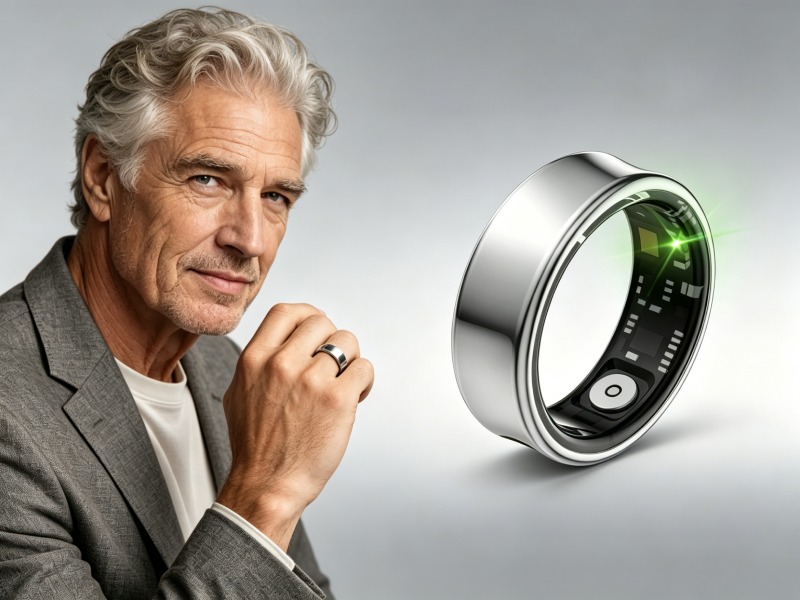
A health ring is a wearable device worn on your finger — usually the index finger — that uses optical sensors, motion sensors, and sometimes electrodes to track your body's vital signs. It looks like a slightly thicker version of a regular ring. Most weigh around 5 grams and are about 8mm wide. You wear it 24/7. It tracks. You check the data on your phone.
The defining advantage over a smartwatch or wristband: you forget you're wearing it. A ring doesn't interrupt sleep the way a watch band does. It doesn't announce itself as a piece of technology. That simple difference in form factor translates to dramatically higher compliance — people actually keep these on.
What can a health ring actually measure?
Different rings have different sensors, but here's what the category can do today:
- Heart rate: Continuous optical PPG (photoplethysmography) tracking through the skin on your finger. More consistent than wrist-based tracking because fingers have better blood flow and less movement artifact.
- Heart rate variability (HRV): The variation in time between heartbeats — a key indicator of stress, recovery, and overall cardiac health.
- Blood oxygen (SpO2): Measures how much oxygen your blood is carrying. Useful for sleep quality assessment and altitude adaptation.
- ECG (electrocardiogram): Some advanced rings include electrodes for single-lead ECG — the same type of heart rhythm measurement you'd get from a medical-grade device, just in ring form.
- Sleep tracking: Detects deep sleep, light sleep, and REM stages by combining movement data with heart rate patterns. More comfortable than wearing a watch to bed.
- Blood pressure: Emerging feature. Uses optical sensors and algorithms to estimate blood pressure. Not a replacement for a cuff, but useful for trend monitoring.
- Skin temperature: Continuous body surface temperature monitoring. Can detect early signs of illness before you feel sick.
- Step counting and activity: Like any fitness tracker — steps, calories, and exercise modes.
How does it actually work?
Underneath the ring, on the side that touches your skin, there are tiny LED lights and a light sensor. The LEDs shine green, red, or infrared light into your skin. The sensor measures how much light bounces back — which changes as your blood pulses through the capillaries in your finger. That's how it reads heart rate (and from heart rate, derives HRV, sleep stages, and more).
For ECG-capable rings, there are metal electrodes embedded in the ring that make contact with your skin. When you touch a specific spot, a tiny electrical circuit is completed, and the ring reads the electrical activity of your heart — similar to the chest leads used in a hospital ECG, just simplified to a single lead.
All the data is sent to your phone via Bluetooth Low Energy (BLE). An app displays trends, charts, and insights. Rings typically store several days of data locally and sync when connected.
Smart ring vs smartwatch: which should you choose?
| Feature | Smart Ring | Smartwatch |
|---|---|---|
| Comfort (24/7 wear) | Excellent | Good |
| Sleep tracking comfort | Excellent | Poor |
| Battery life | 3-5 days | 1-2 days |
| Screen / notifications | None | Full display |
| Health sensor accuracy | Very good | Good |
| Waterproof | IP68 | Varies (typically IP68) |
| Price range | $50-$300 retail | $200-$800+ retail |
The bottom line: if you want notifications, apps, and a screen on your wrist, get a smartwatch. If you want health tracking that disappears into your life, a ring is the better form factor. Many people wear both — a ring for 24/7 health data, and a watch for daytime notifications.
What should you look for in a health ring?
Whether you're buying one for yourself or sourcing them for your business, here are the key specifications that separate a good ring from a bad one:
- Sensor quality: Look for dedicated sensor chips (like the Goodix 3228T for ECG and PPG) rather than generic components. Dedicated accelerometers (STK8321) indicate quality motion tracking.
- Water resistance: IP68 means it can handle showering, swimming, and hand washing without issue. This is the standard for rings designed for 24/7 wear.
- Battery life: 4-6 days of active use is the current standard. Standby should reach 10-15 days. Look for 18mAh or higher capacity.
- Material: 304 stainless steel with epoxy resin body is standard. Anti-scratch matte finish holds up better than gloss or painted alternatives.
- App compatibility: iOS and Android support are table stakes. Look for OTA firmware updates so the ring improves over time.
- Size range: Should cover at least US sizes 7 through 13 (17.3mm–22.2mm internal diameter).
- Certifications: CE, ROHS, and FCC certification indicate the ring has passed safety and emissions testing.
Interested in manufacturing your own health ring brand?
We produce ECG-capable smart rings with customizable features, materials, finishes, branding, and packaging. Start with a sample, scale at your pace.
Frequently asked questions
Do I need a smartphone to use a health ring?
Yes. Health rings use Bluetooth to sync data to a companion app on your phone (iOS or Android). The ring itself has no screen — the app is where you see your trends, charts, and insights.
Can I wear a health ring while swimming?
If the ring is rated IP68, yes. This rating means it is fully dust-proof and protected against continuous immersion in water. You can swim, shower, and wash hands without removing the ring. Check the manufacturer's spec sheet for the exact depth and duration ratings.
How accurate are health rings compared to medical devices?
Consumer health rings are wellness devices, not medical instruments. They're highly consistent for trend monitoring (tracking changes over time) but should not replace medical-grade equipment for diagnosis. ECG-capable rings with dedicated sensor chips approach clinical accuracy for basic rhythm detection.
How do I know what size ring to get?
Health rings are typically worn on the index finger. Sizes range from US 7 to 13, measured by inner diameter (17.3mm to 22.2mm). Most manufacturers provide sizing kits with plastic ring sizers. Measure your finger at the end of the day when fingers are slightly larger.