
How to choose fall prevention equipment for nursing homes: an engineer's guide to procurement
A technical specification review covering material grades, load testing, grip ergonomics, and the supplier audit questions that separate durable equipment from budget placeholders.
In skilled nursing and assisted living facilities, equipment purchasing sits at the intersection of three competing forces: the director of nursing wants gear that reduces incident reports, the CFO wants to stay within capital budget, and the surveyor wants to see compliance documentation. This guide walks through the engineering details that matter for each category of fall prevention equipment — not marketing claims, but the material specs, test standards, and failure modes that determine whether a product lasts five years or needs replacement in two.
What you'll take away from this guide
- How to match equipment categories to resident mobility risk levels
- Why SS304 vs SS201 is the single most important material decision for bathroom grab bars
- What to look for in cane grip materials, adjustability mechanisms, and failure points
- How to evaluate transfer chair casters and slide board edge geometry
- A supplier audit checklist you can drop directly into your next RFP
Risk stratification: match the equipment to the resident
Fall prevention equipment procurement should follow the same logic as clinical risk assessment. A resident with advanced dementia who wanders at night needs different engineering controls than a generally independent resident who uses a cane for confidence on long hallway walks. The table below maps standard mobility levels to the equipment categories that address each risk profile.
| Mobility Level | Status | Primary Risk | Equipment Category | Engineering Emphasis |
|---|---|---|---|---|
| High Risk (Level 1) | Non-ambulatory, severe cognitive impairment | Unsafe wandering, unassisted transfers | Low beds, bed exit alarms (specialized third-party equipment) | Reliable sensor triggering, low deck height, tamper resistance |
| Moderate Risk (Level 2) | Ambulatory with supervision, unsteady gait | Fatigue, environmental hazards in bathrooms | Wall-mounted grab bars, transfer chairs | Static load capacity, anti-slip surfaces, corrosion resistance |
| Low Risk (Level 3) | Generally independent, requires occasional support | Deconditioning, loss of balance on long walks | Walking canes, rolling walkers | Ergonomic grip, correct height adjustment range |
1. Grab bars: the material grade is the product
The bathroom is the highest-risk zone in any nursing facility. According to the CDC's nursing home fall data[1], a typical 100-bed facility records 100–200 falls annually, with a disproportionate share occurring during toileting and shower transfers. Grab bars are the primary engineering control for these zones — and the most important thing to understand about them is the material.
SS304 vs. SS201: why the nickel content matters
A common cost-cutting move in bulk procurement is substituting SS201 stainless steel for SS304. The difference is metallurgical: SS201 contains roughly 1–1.5% nickel, while SS304 contains 8–10.5%. Nickel is what gives stainless steel its corrosion resistance in chloride-rich environments — like bathrooms where chlorine-based disinfectants are used daily. Over 18–24 months in a humid shower environment, SS201 develops surface pitting and rust at weld points and flange connections. SS304 does not.
The practical question to put to your supplier: "What is the exact stainless steel grade?" If the answer is "stainless steel" without a grade number, assume 201. A supplier who knows their metallurgy will answer "304" without hesitation.
Load testing: what to ask for
The 2010 ADA Standards for Accessible Design, Section 609[2] specify that grab bars must support a 250 lb (113 kg) load. This is the regulatory floor, not the engineering ceiling. Industry best practice, codified in ISO 17966:2016 — Assistive products for personal mobility[3], dictates that grab bars should withstand this load for a minimum of 5 minutes without permanent deformation. When auditing a supplier, request documentation that their bars were tested to this standard.
The failure point to inspect is the wall flange — specifically, the weld or crimp joint where the bar meets the mounting plate. In our experience, the bar itself almost never fails; the connection to the wall does. Check whether the flange is a single-piece forging (strongest), a welded assembly (good, if TIG-welded with proper penetration), or a crimped fitting (acceptable for dry indoor use, but the first to loosen under repeated loading).
Tube diameter and grip surface
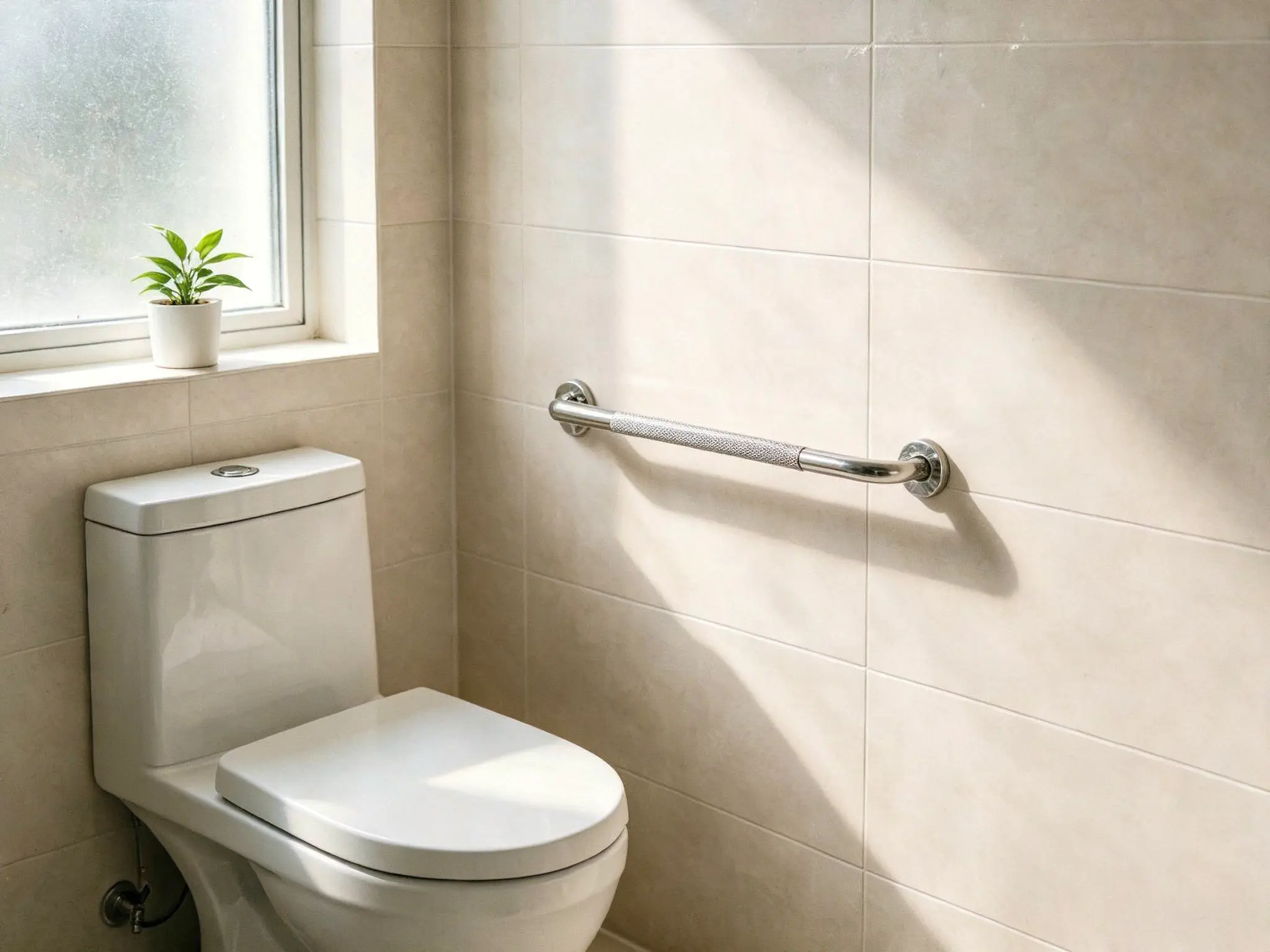
Commercial-grade grab bars use 32mm (1.25") diameter tubing. Consumer-grade bars use 25mm. The difference matters: a 32mm tube provides more surface area for the grip pattern, feels more substantial under load, and resists bending at longer spans. For grip surface, machined knurl patterns cut directly into the metal outperform plastic sleeves and spray-on coatings — they cannot peel, crack, or wear smooth after years of daily use and chemical cleaning.
2. Walking canes: the grip and the lock define the product
A walking cane looks simple. That simplicity means the few components it does have carry all the engineering load. Two details separate a cane that works for years from one that becomes a liability in months: the handgrip material and the height adjustment lock.
Handgrip: foam fails first
Standard EVA foam grips — common on retail canes — degrade rapidly when exposed to the quaternary ammonium and bleach-based disinfectants used in healthcare settings. Within 6–12 months of daily wiping, foam becomes tacky, absorbs cleaning chemicals, and begins to crumble at the edges. Silicone grips avoid all of these failure modes. Silicone is non-porous, chemically inert against common disinfectants, and maintains consistent surface friction even when wet — a property foam grips lose as they absorb moisture. When evaluating canes for bulk purchase, ask the supplier: "What is the grip material, and has it been tested for chemical compatibility with quaternary ammonium disinfectants?"

Adjustability: tolerance is safety
A cane adjusted to the wrong height shifts the user's center of gravity forward or sideways. Residents need 1-inch increments for precise fitting. The locking mechanism must eliminate play between the inner and outer telescoping tubes — a rattling, loose connection erodes user confidence and encourages residents to leave the cane in their room rather than use it. During quality checks, we inspect the fit clearance between telescoping sections. Any lateral movement at the joint when locked is a QC rejection.
3. Transfer chairs: the caster lock is a safety-critical component
Resident transfers — bed to chair, chair to toilet, chair to shower — are the moments where falls are most likely and most consequential. A transfer that goes wrong can injure both the resident and the caregiver in a single incident.
Caster systems: stability during the transfer sequence
When selecting a transfer chair, the most important engineering detail is hidden at floor level: the casters. During a pivot transfer, the chair must be absolutely stationary. A caster that locks wheel rotation but still allows the swivel to rotate creates a pivot point — the chair can spin under the resident's weight, defeating the lock entirely. Look for casters that lock both rotation and swivel simultaneously. Ask the supplier: "Does the caster lock prevent both wheel roll and swivel rotation?" If the answer is unclear, ask for a demonstration video.
Slide boards: the edge profile matters
For lateral transfers — bed to stretcher, for example — slide boards are simple but unforgiving of poor manufacturing. They should be constructed from high-density polyethylene (HDPE) for low friction and chemical resistance. The quality control check that separates a safe board from a hazard is the edge geometry: every edge must be fully radiused (rounded) and polished smooth. A sharp edge or burr left from the cutting process can tear resident skin during a transfer. Run your finger along every edge of a sample unit before approving a bulk order.
Transfer placement — when positioning the chair for a bed-to-chair transfer, the critical safety component is the caster locking mechanism — the part you cannot see in any product photo. Verify that all four casters lock, not just two. A two-lock configuration leaves a pivot axis along the line between the unlocked casters, and that is exactly the axis along which a transferring resident's body weight will shift the chair. Four locked casters turn the chair into a fixed platform; two locked casters leave it a rotating object.
4. Environmental integration: equipment doesn't work in isolation
Fall prevention equipment exists within a physical environment, and the interaction between the two is where subtle failures occur. Two factors are consistently under-discussed in procurement conversations.
Color contrast and depth perception
For residents with age-related vision decline — reduced contrast sensitivity, impaired depth perception — a stainless steel grab bar mounted on a white tile wall is functionally invisible. The bar is there physically, but the resident cannot locate it quickly during a loss of balance. The fix is straightforward: specify grab bars and toilet seats in a color that contrasts with the surrounding wall and floor finishes. A brushed stainless bar against a dark-painted wall, or a dark-finish bar against white tile. This is an architectural specification, not a product feature — which means procurement needs to coordinate with facilities management before ordering.
Lighting at transition points
The doorway between bedroom and bathroom is the single highest-risk transition point in a resident room. Residents typically navigate this path at night, in low light, often without their walking aid. A motion-activated LED night light at baseboard level — independent of the room's main lighting circuit — provides low-level illumination that marks the threshold without disturbing sleep. This is a $15 part that addresses a risk no grab bar can solve on its own.
Procurement audit checklist
Use this checklist when evaluating suppliers. These questions require no specialized testing equipment to verify — just a supplier who understands their manufacturing process and is willing to document it.
| Component | What to Specify | Supplier Audit Question |
|---|---|---|
| Grab Bars | SS304, 32mm tube, knurled grip | "What is the stainless steel grade? Can you provide independent load test documentation?" |
| Cane Grips | Silicone, ergonomic profile | "What is the grip material? Has it been tested with quaternary ammonium disinfectants?" |
| Transfer Chair Casters | Dual-lock: wheel + swivel | "Does the caster lock prevent both wheel rotation and swivel movement?" |
| Documentation | Material certs, test reports | "What quality management system does your factory operate under? Can you provide material certificates?" |
By focusing on these engineering details rather than brochure copy, you shift the supplier conversation from price to value — and your facility gets equipment that performs across years of daily use rather than months.
Need technical documentation for your facility's procurement review?
Our engineering team can provide material specifications, load test reports, and compliance documentation for any product in our catalog — before you commit to an order.
Frequently asked questions
How many grab bars does a typical nursing home bathroom require?
ADA standards specify a minimum of two grab bars per toilet area (side wall and rear wall) plus two in the shower or bathtub area. For bariatric rooms or high-acuity units, plan for 4–6 bars per bathroom. A 100-bed facility typically needs 80–120 bars total.
How do I verify a grab bar supplier's material claims without lab testing?
Request the material certificate (mill test report) for the stainless steel used. This document identifies the grade, chemical composition, and mechanical properties. A supplier who cannot produce it is likely sourcing from secondary markets where material grade cannot be verified. Also, order a sample and check the weight — SS304 is denser than SS201, and an experienced hand can feel the difference in wall thickness and heft.
What is the most overlooked fall prevention measure in nursing homes?
Lighting at transition points — specifically the path from bed to bathroom at night. Most facilities have adequate daytime lighting but rely on a single overhead fixture at night, which residents either cannot reach or will not turn on to avoid disturbing a roommate. Motion-activated LED night lights at baseboard level address this gap for under $20 per room. This is not a product we sell; it is simply the most cost-effective fall prevention measure most facilities overlook.
Should I standardize on one finish for all grab bars across my facility?
Yes, with an exception. Standardizing on one finish and 2–3 lengths simplifies maintenance inventory and ensures consistent appearance. The exception is color contrast: if your bathroom walls are white or light gray, consider a darker finish (matte black or dark bronze) for at least the bars residents grip during transfers. The contrast helps visually impaired residents locate the bar quickly.
References & Footnotes
- CDC. Falls in Nursing Homes — Data and Prevention. Centers for Disease Control and Prevention. ↩
- U.S. Access Board. 2010 ADA Standards for Accessible Design, Section 609: Grab Bars. ↩
- ISO. ISO 17966:2016 — Assistive products for personal mobility. International Organization for Standardization. ↩